
Work & Academia
AI Projects and
Research
A collection of micro AI projects centered on designing,
implementing, and shipping intelligent systems. The work spans product development, system integration, and applied evaluation.

Currently scaling the AI vertical across the fire and life safety industry at Hazard Control Technologies, INC.
One example is an AI-powered knowledge assistant I designed and launched to help users find, understand, and apply organizational information more efficiently.
The work covered the full product lifecycle, from defining the user experience and interaction flows to shaping the system architecture and implementation. The assistant uses a Python-based backend, retrieval-augmented generation, and a lightweight web interface to deliver fast, reliable, and context-aware answers.
Project 1: AI Ecosystem
(Work)
Project 2: Job Seeking Chrome Extension
Designed and built a custom Chrome extension to analyze LinkedIn job postings in real time.
The extension uses JavaScript-based pattern recognition to parse job listings and extract key information such as visa sponsorship indicators, compensation ranges, and location or work modality (remote, hybrid, or on-site).
In addition to metadata extraction, the system analyzes job descriptions to support resume tailoring by identifying relevant skills and experience signals for each role. This reduces the need for manual review and repetitive resume customization during the application process.
The extension integrates directly into LinkedIn’s interface and surfaces insights through a lightweight popup panel. It is built with vanilla JavaScript and modular CSS, operates entirely client-side, and avoids external dependencies to ensure fast, reliable performance.
Project 3: AI Tools Suite
This project explores how AI can be applied as a practical operating layer for early-stage founders managing marketing, content, and growth workflows. I designed and built a modular AI tools suite that integrates multiple task-specific agents into a single, cohesive product experience, focused on speed, clarity, and decision support rather than automation for its own sake.
The work spans product design, system architecture, and end-to-end implementation, with an emphasis on building tools that slot naturally into real founder workflows.
What I Built:
I designed and implemented an AI-powered tools suite composed of multiple focused modules, each addressing a distinct marketing need:
- AI Assistant: Conversational interface for contextual queries, planning, and execution support across marketing tasks.
- Trend Intelligence:Real-time aggregation and analysis of trending content across platforms (X, Reddit, TikTok, Instagram, YouTube), surfaced as actionable insights rather than raw data.
- Content Studio:A Google Sheets–native workflow for generating brand strategies, content calendars, audits, and copy—built as a custom Apps Script extension with AI-backed actions.
- MCP Platform: A demonstration of structured AI orchestration, showing how shared context can be passed across tools to maintain continuity between analysis, generation, and execution.
- AI Sales Copilot:Exploratory module focused on outbound and prospecting workflows across Slack, email, and social platforms.
Project 4: TESS - Personal Context Layer (Personal-WIP)
TESS is a local-first personal context system that learns how I work across my devices and surfaces the next useful action for me to review and approve.
Most assistants begin with a prompt. TESS explores what happens when context comes first. Instead of waiting for me to explain what I'm doing, it builds an evolving picture of my activity, connects signals across it, and anticipates what may be useful next — not to act on its own, but to shorten the gap between recognizing what needs to happen and doing it.
TESS
The work spans product design, interaction design, system architecture, and implementation, and, just as much, deciding what not to build yet: reducing a broad ambient-computing concept to a small, reliable foundation that can support more capable behavior over time.
Design approach
TESS is built around four principles:
- Human-in-the-loop: TESS can draft and suggest, but anything consequential stays behind an explicit approval step.
- Augmentation over automation: remove friction from decisions and workflows while keeping the user in control.
- Confidence-aware: when context is weak or ambiguous, TESS defers rather than manufacturing certainty.
- Privacy by architecture: the context layer runs locally, keeping behavioral data on-device rather than sending it to external services.
Foundation:
I built the architecture before the features. The first thing to exist isn't a capability; it's a boundary: a layer that can observe, walled off from anything that can act, with a single approval step as the only path between them. Building that first means TESS can grow more capable without ever becoming less predictable.
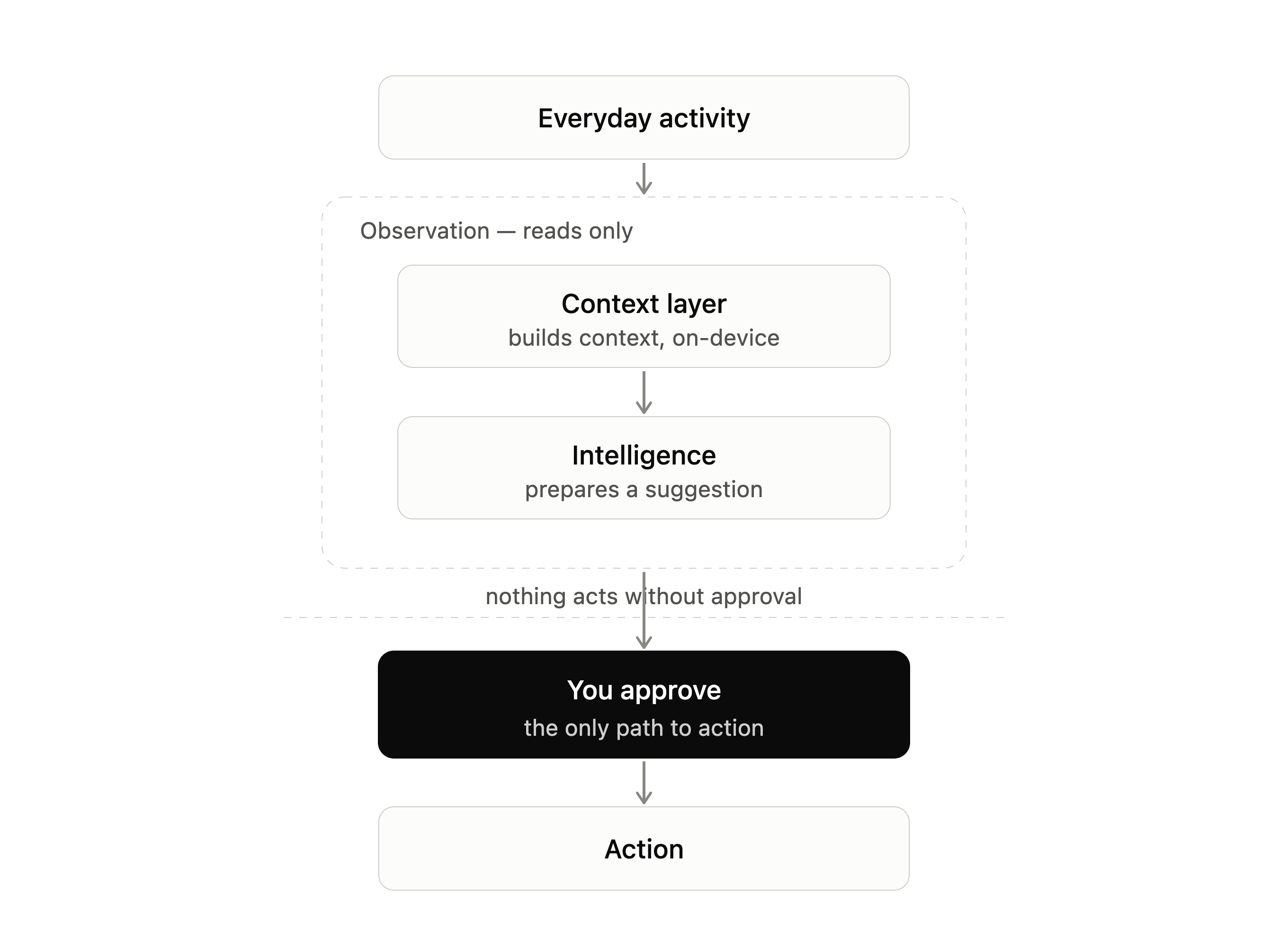
The observe/act boundary: everything that reads is walled off, and the one path to action runs through my approval.
Roadmap:
- Context: establish a reliable local record of activity.
- Intelligence: interpret it, identify relevant connections, and prepare suggested actions.
- Coordination: extend context across devices, routing every suggestion into a single approval experience.
Each stage depends on the one before it: intelligence is only useful once the context is trustworthy, and cross-device coordination only earns its place once the suggestion model has proven itself.
Current Status:
In development, foundation phase - proving the local context layer before introducing recommendation and multi-device capabilities.
Project 5: Human-Centered AI Analysis — Bumble Safety Features
(Research)
This analysis mapped Bumble’s Private Detector and Deception Detector to established Human-Centered AI (HCAI) principles to understand how AI-driven safety features are translated into trustworthy, user-facing product experiences.
Human-in-the-Loop / Control: AI surfaces risk signals but does not take action. Users retain full control over how to respond.
Augmentation over Replacement: Safety features enhance user awareness rather than making social decisions on the user’s behalf.
Transparency & Explainability: Interventions are framed as indicators, not definitive judgments, supporting informed decision-making.
Fairness & Non-Discrimination: Detections focus on behavioral patterns, avoiding identity-based labeling or stigmatization.
Privacy & Security: Analysis occurs within private conversations without exposing or persisting sensitive content.
User-Centered Design & Empathy: UX language emphasizes support and safety, not enforcement or alarm.
Accountability: Clear user actions (report, seek support) are provided when interventions occur.

Beyond the easel, I host conversations with people building what's next.
Discover my skills
and passions
School Project
Region Agnostic
Dashboard
Learn More >

School Project
RecruiterMatch
Learn More >